

How to Write a Case Study with Examples
The 9-step formula detailed below will teach you how to write a winning business case study. And we’ll walk through the process using real case study examples. You'll find all the information you need to write a polished case study that will generate leads and help close sales.

When you can write an effective case study, you’re creating a powerful sales tool for your business or client. That’s because a case study is a compelling, real-world, “before and after” story that shows how a customer solved a problem by using a company’s product or service.
The customer (not the company’s sales team) is the credible source telling a story that’s relevant and valuable to the prospect.
Businesses love case studies, because they’re a huge step beyond a simple testimonial. They help give a prospect an understanding of how a customer accomplished their goals by using their product.
In a competitive marketplace, case studies are an effective way for businesses to differentiate themselves from their competitors.
If you’re in business, starting a business, or writing for a business … knowing how to write a case study is a valuable skill that will help you generate a pipeline of leads and close sales. And if you’re a marketer, it’s another profitable skill to have in your marketing arsenal.

(Download a PDF of the full case study here to follow along with the video.)
Let’s look at the specific steps for writing an effective case study, along with a few other tips that will help make your case study a success.
How to write a case study in 9 easy steps
Writing a case study is quite simple, as long as you know the proven formula business writers generally follow. The nine main components of writing a case study are …
-
A news-like headline — The most effective case study headlines focus on one idea that communicates relevant benefits to your target audience in a compelling way. You don’t need to be clever or adopt a sales tone with your headline. Your goal is to be objective and straightforward. For your headline to have the most impact, you should include tangible figures.
Here are a couple of examples:
The Wilson Group Increases Throughput by 312% Using Mason Douglas
Noble Corporation Helps ABC Medical Increase Production Output by 37% in Six Months
The above examples are focused on one idea only and state the main benefit or result received. You could also tack on how the result was achieved using a “cause and effect” headline format, like this:
The Wilson Group Increases Throughput by 312% by Streamlining Their Assembly Line with Mason Douglas
The cause is the streamlining of the assembly line; the effect is the 312% increase in throughput.
Headline Tips:
- Focus on one big idea.
- State it almost like a newspaper headline and make sure it will appeal to the prospect and what they’re trying to solve or achieve.
-
Customer background — In this section, you’ll describe the business customer in three to six sentences. This should total 50 to 100 words. Here is some of the customer-related information you may want to include:
- Where the customer’s business is headquartered
- What the company manufactures or sells or delivers
- What types of customers they target
- How long they’ve been around or when they were founded
- The number of employees
- Their number of locations
- Their main product lines or service offerings
- What makes the company and their products or services different
It may be difficult to include all seven of these points within the targeted word count. Your mission is to pick the most relevant information based on your target audience and the story you’re telling in your case study.
Two places to look for information about the customer’s company are in the “About Us” section of a recent press release and the “About Us” page of their website. You can also fill in any information missing from your research during the interview with the customer.
-
The challenges — Here you want to introduce and expand on the main challenges the customer was facing as related to the product or service featured in your case study.
The key here is to create a compelling story. Don’t just list the challenges; go a little deeper into the impact the challenges were having on their overall business.
Explain why it was important to solve them, why and how they were impacting the customer, and to what degree. Do this with two or three key challenges, as long as they tell a specific story related to the solution.
Your goal is to make your reader feel these challenges are too important and too meaningful to be ignored, and that a solution must be found to overcome them. Remember, the prospect is likely facing the same challenges as the customer in your case study, so the more descriptive you are, the better.
- The journey — In this section, document the journey to the solution and the results. You’ll talk about the research the customer did in search of a solution. You’ll outline the pros and cons of the options they considered and why they ultimately chose to go with the featured company’s product or service. This section adds depth and credibility to your story, as a prospect considering the same solution usually goes through a similar process.
- The solution — This is where you showcase the product or service as the answer to the customer’s challenges. Your goal here is to introduce the product or service in an educational, non-salesy way.
-
The implementation — Next, explain how the product or service was implemented. The key to this section is to paint an accurate picture.
It’s rare for an implementation to go 100% perfectly. So, to boost the authenticity of this section, document how the implementation went — warts and all — and then how the company overcame it. This will make your story more believable and compelling.
-
The results — This is where you detail how well the product or service solved the customer’s challenges. Focus on results metrics (tables, charts, increases in production, efficiency, revenue, etc.) that are both specific and relevant to the target audience. Tell them what was achieved and how.
Explain why the results are important to the customer and the impact they’ve had, both specific to the department the results were achieved in and the impact on the overall business.
Tip: BE SPECIFIC! Include facts, numbers, and charts. Use tangible and detailed figures. For instance, “increased sales by 17.5%” is much better than just “increased sales.”
- Sidebar with summary points — To help busy executives who want to get the gist of the story without reading the entire case study, include a sidebar with a summary of the story and its main points. Write these so compellingly they instantly grab your reader’s attention.
- Pull-out quotes — You’ll want to pick one or two strong, relatively short customer quotes about solving the problem to use as a pull-out or featured quote. These quotes will add visual interest to your case study and will grab the attention of people who are simply scanning the content.
If you’ve been wondering how to write a case study, you can’t go wrong with the above formula. It’s been proven to work and is an extremely safe bet.
Case study examples
Case Study Example #1 — AVOXI Integrated Solutions

The first case study example is a business-to-business (B2B) case study showcasing AVOXI Integrated Solutions and their client, Grace Bay Resorts
A News-like headline (#1)
Grace Bay Resorts Cuts Phone Costs by 75-85% while Enhancing Guest Services.
This headline tells the reader what potential benefits they’ll experience, a reduction in costs and an improved guest experience. The writer increases the headline’s impact by making it very specific (75-85% cost reduction).
The subhead, Resort Gains Flexibility, Reliability with AVOXI Integrated Solutions, adds two more benefits and then names the solution.
The Customer Background (#2)
The first paragraph (44 words) gives a quick overview of the company:
With a focus on handmade experiences, Grace Bay Resorts has earned hundreds of awards and accolades since opening in 1993. Their award-winning flagship property Grace Bay Club in Turks & Caicos offers beachfront destinations in three distinct settings: hotel, villas and beachfront villa homes.
It answers three more questions potential buyers have: When they opened, where they are located, and what they offer.
The Challenges (#3)
In the second paragraph, the writer transitions into challenges Grace Bay faced. He starts by stressing how vital effective communication services are to Grace Bay’s results. The challenge is finding a provider who offers the latest technology at an affordable cost:
Grace Bay aims to treat every guest and prospective guest as a VIP. To do so, it relies heavily on its communication solutions to field hundreds of calls every month, and to keep guests connected during their stays. The ability to operate seamlessly during customer calls is essential to the resort’s business model and hands-on reputation.
In the past, the company lacked a contact center solution with modern features such as automated greetings, call recording and call center metrics. And, it paid heavy long-distance costs with a local carrier.
The Journey (#4)
In this case study, the copy describing the journey is short and concise. The IT Manager was sold on the AVOXI solution instantly when he heard about it:
When Leo Lumacang heard about AVOXI cloud solutions, the business case was clear. “When I presented to management that we would save thousands and thousands of dollars by switching to AVOXI, it was an easy sell,” says Lumacang, IT Manager at Grace Bay. “We cut out costs by probably 75-85 percent immediately.”
The Solution (#5)
The majority of the 2nd page of the case study focuses on the solution including this excerpt that lists the AVOXI solutions that were implemented.
Grace Bay deployed a set of integrated cloud solutions from AVOXI, including a cloud-based phone system, virtual contact center software, a VoIP gateway and international toll-free numbers—all solutions that enhance the guest experience, and reduce costs and management hassles for the resort.
They go on to describe the features of the virtual contact center software and how it was used by the reservation center to improve their service levels.
The Implementation (#6)
The implementation phase of the product or service is a section that is not always documented in case studies. The reason for this is simple. There is nothing notable that came out of the implementation. In this case study, the writer focuses more on what was implemented (the solution) than on how it was implemented.
The Results (#7)
The results are detailed in the last three sections. The AVOXI solution resulted in significant improvements in Grace Bay’s reservation center operations. It also helped improve the guest experience by allowing the resort to provide free international toll-free calls. And finally, they highlight the reliability of the system and the efficiency and effectiveness of AVOXI’s customer support.
A Sidebar with summary points (#8)
In the left column on the second page, the writer adds a brief summary of the case study, listing the four components that make up the solution and three bullet points of the results experienced.
Pull-out quote (#9)
Pull-out quotes are used on pages 1 and 3 and focus on the improvements in service levels, one of the biggest concerns for the customer.
Case Study Example #2 — AWAI
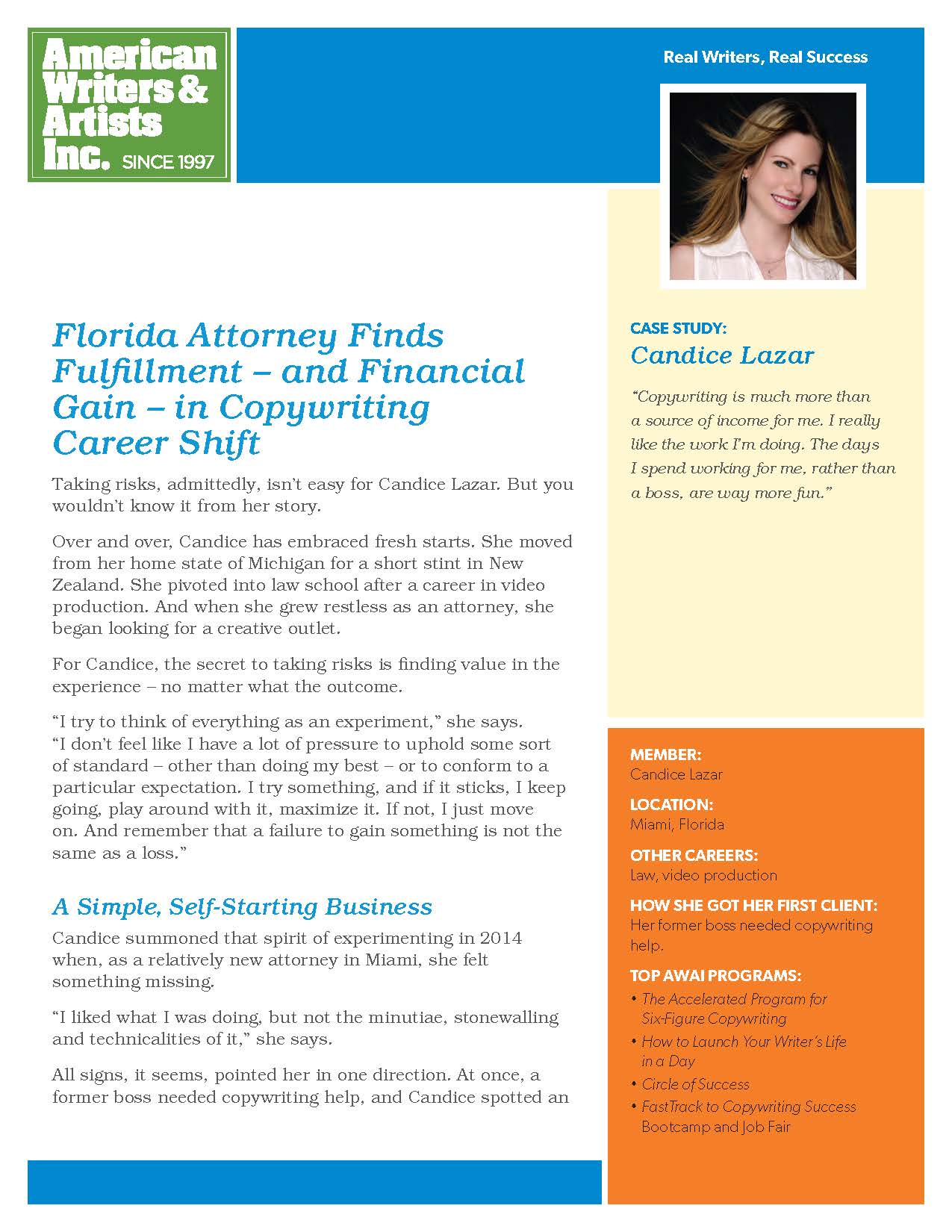
The second case study example is a business-to-consumer (B2C) case study showcasing American Writers & Artists (AWAI) and one of their customers, Candice Lazar.
A News-like headline (#1)
Florida Attorney Finds Fulfillment — and Financial Gain — in Copywriting Career Shift.
The headline is straightforward and reads very much like a news headline. The message of a successful career change to copywriting is aimed at prospects who may have similar goals.
The Customer background (#2)
The first few paragraphs give information about the Candice’s background by talking about her experiences and attitude towards risk-taking.
The Challenges (#3)
Her main challenge is revealed under the sub-head “A Simple, Self-Starting Business.” She “felt something was missing” in her job as an attorney. According to a recent Gallup study, 51 percent of Americans aren’t engaged in their work and another 16 percent are “actively disengaged,” so it’s an issue many people relate to.
The Journey (#4)
Her journey starts when a former boss tells her he needs copywriting help. She spots a banner from AWAI which gets her thinking that writing might be a good career for her as it’s something she’s always enjoyed.
The Solution (#5)
Candice’s goal is to learn as much about copywriting as she can. The solution is a variety of AWAI products.
The Implementation (#6)
Candice first joins the Barefoot Writer Club, she consumes The Accelerated Program for Six-Figure Copywriting. She also takes How to Make Money as a Social Media Marketing Expert and takes part in Joshua Boswell’s How to Launch Your Writer’s Life in a Day.
Under the subhead “Candice’s Niche Switch” it talks about how Candice originally chose small hotels and hotel chains as her copywriting focus. She soon realized that they don’t require a lot of marketing material. Acknowledging a setback or addressing a challenge is important because it adds to the credibility of Candace’s story.
The Results (#7)
The third page of the case study talks about Candice’s copywriting successes including the growth of her business which has allowed her to cut back to part time hours on her less fulfilling legal work.
A Sidebar with summary points (#8)
There is a sidebar that gives basic information about Candice and the AWAI products that helped her launch her writing career.
Pull-out quotes (#9)
The first page contains a pull-out quote from Candice that focuses on her results … a copywriting business that is more than just a source of income. It's enjoyable and rewarding work.
The “feature article” case study format
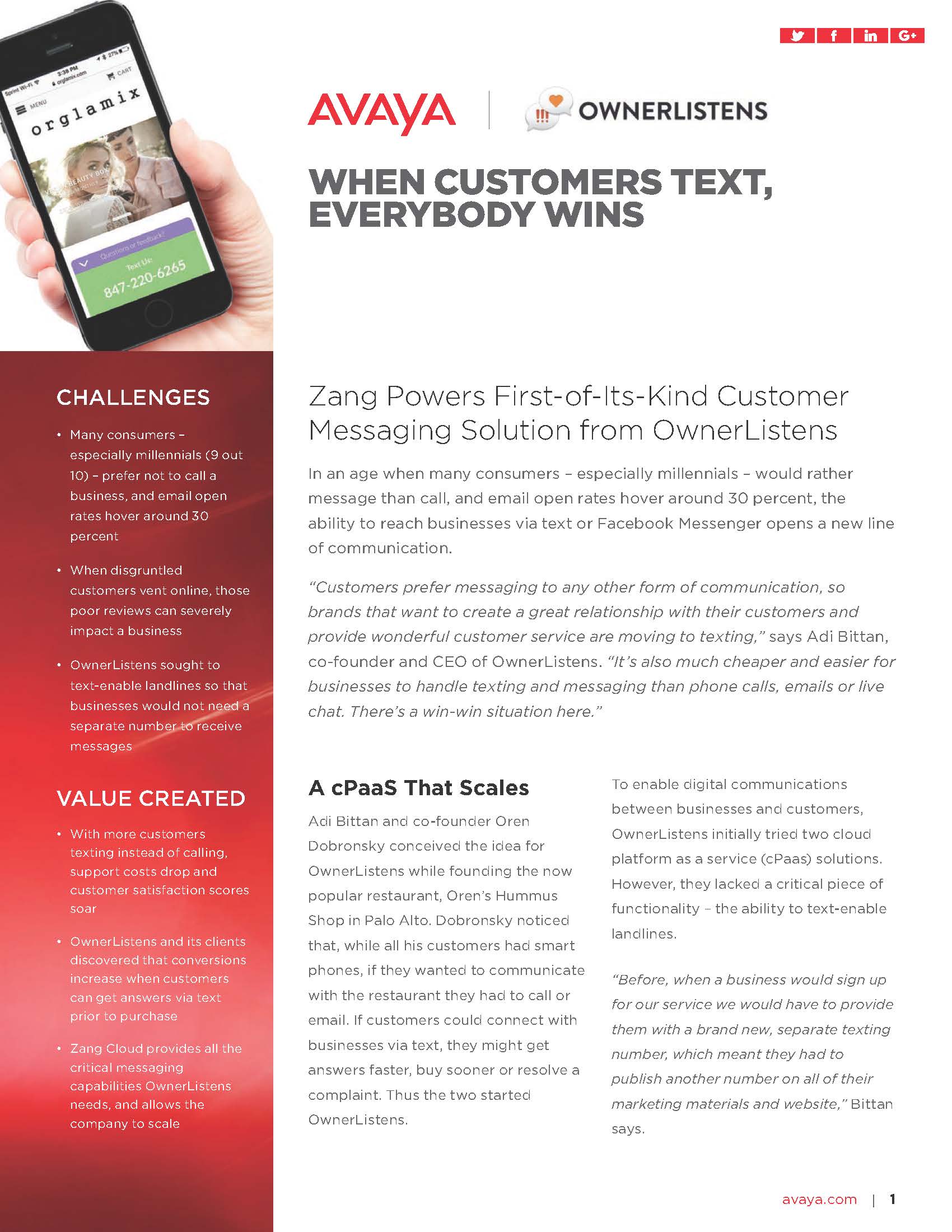
The main difference between the traditional case study format and the feature article format is how the case study starts. The traditional format starts out with some basic information about the customer. The feature article format starts out with an interesting, engaging lead that usually talks about the challenge the customer was facing.
Then it goes to the information about the customer, followed by more information about the customer’s challenge.
After that, it follows the same format as outlined above for a traditional case study.
The other difference is that a feature article uses more descriptive subheads to draw the reader in, versus the traditional format’s somewhat straightforward subheads (Customer Background, The Challenges, etc.).
The feature article format works well when you want to make the story engaging right from the start. Plus, it tends to be better suited for people who want to understand the gist of the case study quickly by merely skimming the pages.
Case study success tips
Use this as a handy checklist when writing your next case study.
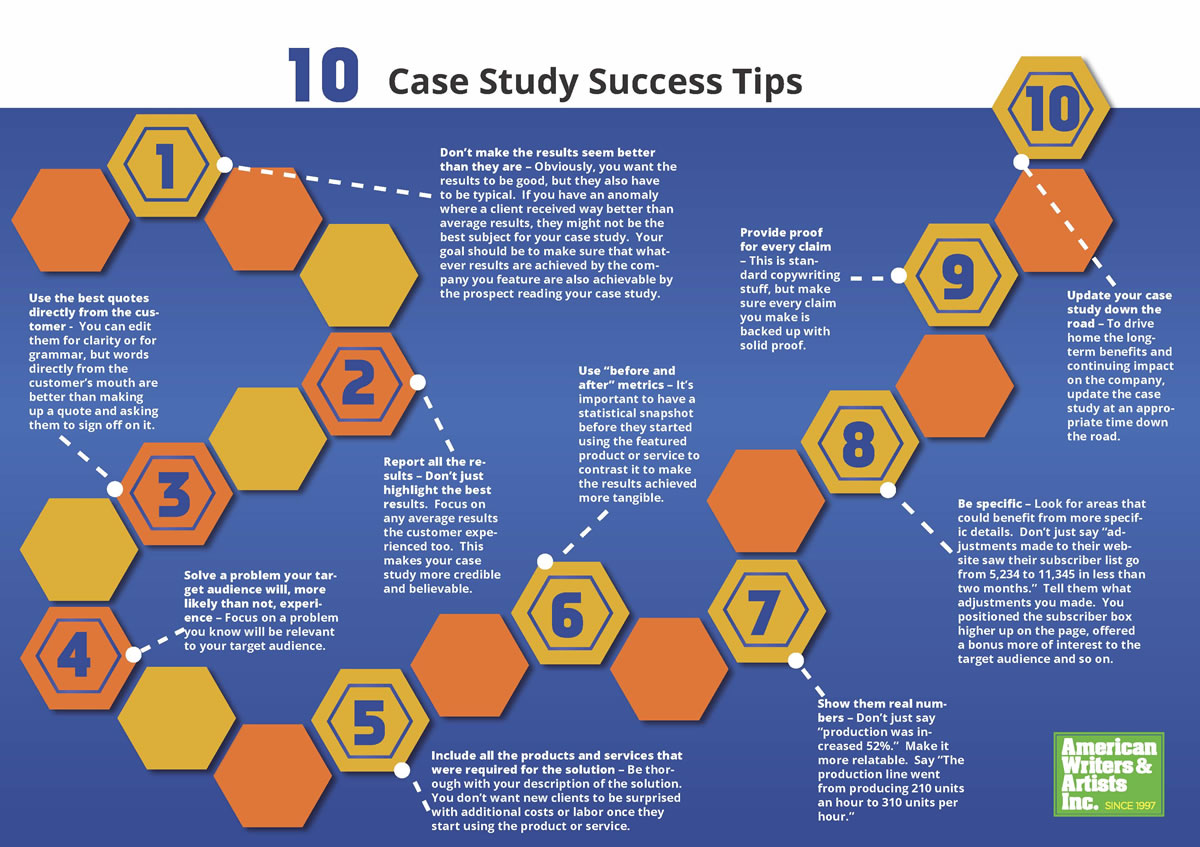
- Don’t make the results seem better than they are. Obviously, you want the results to be good, but they also have to be typical. If you have an anomaly, where a customer received much better than average results, they might not be the best subject for your case study. Your goal should be to make sure whatever results are achieved by the customer you feature are also achievable by the prospect reading your case study.
- Report all the results. Don’t just highlight the best results. Focus on any average results the customer experienced, too. This makes your case study more credible and believable.
- Use the best quotes directly from the customer. You can edit them for clarity or for grammar, but words directly from the customer’s mouth are better than making up a quote and asking them to sign off on it.
- Solve a problem your target audience will, more likely than not, experience. Focus on a problem you know will be relevant to your target audience.
- Include all the products and services that were required for the solution. Be thorough with your description of the solution. You don’t want new customers to be surprised with additional costs or labor fees, once they start using the product or service.
- Use “before and after” metrics. It’s important to have a statistical snapshot of the customer’s situation before they started using the featured product or service, and then contrast it to the results achieved after using it. This will make the results more tangible.
- Show them real numbers. Don’t just say, “Production was increased 48%.” Make it more relatable. Say, “The production line went from producing 210 units an hour to 310 units per hour.”
- Be specific. Look for areas that could benefit from more specific details. Don’t just say, “Adjustments made to their website saw their subscriber list go from 5,234 to 11,345 in less than two months.” Tell them what adjustments you made. You positioned the subscriber box higher up on the page, offered a bonus more of interest to the target audience, and so on.
- Provide proof for every claim. This is standard copywriting stuff, but make sure every claim you make is backed up with solid proof.
- Update your case study down the road. To drive home the long-term benefits and continuing impact on the featured customer, update the case study at an appropriate time down the road.
- Use the “Power of One.” One of the most powerful copywriting principles is the “Power of One,” which is to focus on one story in the case study — one challenge, one solution, one “big wow” impact on how it made a difference.
Ed Gandia, author of Writing Case Studies, says it’s important to keep the “Power of One” top of mind when writing your case study …
 Ed Gandia
“The plot of a good success story often has multiple themes or ideas. When writing a case study, it’s very tempting to highlight all of them in order to dramatize the story. Doing so, however, can confuse the reader and rob the story of its one key theme. So, stick to one theme — one big idea. Your draft will be much stronger as a result.”
BONUS: How to promote your case study
A great case study can be the foundation for additional content-marketing opportunities. Try the following clever ways to promote your case study and generate loads of leads for your business:
- Newsletter — Write a story that covers the key details of the case study and include it in your newsletter with a link to access it.
- Webinar — Present a webinar that focuses only on the case study or features it as proof of the claims made about a product or service.
- White paper — Present a case study in a sidebar of a white paper or feature it as part of the narrative within the body copy.
- Sales presentation — Feature a case study in a sales presentation to add credibility to the benefits promised.
- Article or blog post — The problem/solution story that’s at the heart of your case study makes an interesting and informative article topic or blog post.
- Event handout — A case study is an ideal handout at an industry event or a speaking engagement.
- Email signature — Add a sentence or two to your email signature, such as, “Click here to see how company ABC improved their profits by X% in less than six months.”
- Press release — Announce to the world that one of your customers or clients has solved a problem or is operating more efficiently, thanks to one of your products or services.
- LinkedIn — Promote your case study on LinkedIn by posting an article and linking it to a blog post or article. Plus, join groups made up of your target audience and subtly promote your case study within the group.
- Video — Some prospects prefer watching a video over reading two to four pages of copy. If it’s in the budget, create a video based on your case study.
- Social media — Tweet about it, post pictures related to it on Pinterest, or post a video/webinar on YouTube.
- Dedicated case study page — Provide a summary of the case study (Customer’s Company Name, Headline, Problem, Solution, Results) and a link for readers to download the complete case study as a PDF.
- Your homepage — If the case study is hot off the press, a great way to attract attention to it is to mention it on your homepage.
- Product or service sales page — A real-life customer experience just might be the push a prospect needs to become a customer.
- SlideShare presentation — Turn your case study into a detailed presentation, post it on LinkedIn’s SlideShare website, and take advantage of their 60-million-strong audience.
Tip: Several of the above marketing options also give a business an opportunity to capture a prospect’s email address in exchange for giving them access to the case study.
Want to dive deeper into learning how to write case studies?
If you enjoy writing stories, prefer shorter projects over longer assignments, and love the challenge of taking a straightforward story and finding the “hook” or “angle” that will make it more compelling to bring in business leads and sales … writing case studies might be of interest to you.
Ed’s program, Writing Case Studies, may be the fastest, easiest way to get started writing case studies that will “wow” your clients. Here’s what you’ll discover…
- An overview of case studies — What they are, what they’re used for, who reads them, and why they’re effective.
- How to write an effective case study — What elements to include and what purpose each element serves. You’ll know the exact formula to follow to write an effective and compelling case study.
- The planning of your case study — From the initial discovery call to obtaining a personal commitment from the customer (the interviewee), you’ll know the necessary steps to take to ensure your case study project goes smoothly.
- How to conduct a tightly focused interview — If done right, you should be able to get all the information you need in about 30 minutes. Ed details how to get the information you need to write the most powerful story possible.
- How to write your case study draft — The actual step-by-step process you should use to get your draft down in a document and what you can do to make the flow of copy as effective and persuasive as possible.
- Everything you need to know about how to market yourself as a case study writer — What questions to ask before you provide a quote … how to price your projects profitably … and how to increase your chances of landing the work.
- And, much more …
To find out more information about how to become an expert case study writer, click here.

This is just So Great... I love AWAI. Thank you.
But If I submmit a Written Case study today, how long will it take me to get a feedback from AWAI?
Thank You.
Guest (Abraham) –
This was great! All the information was well presented. I'm sure to use this in the field.
Corance –
I want to practice, so I will do one on Barefoot, and others. Can I turn these in for comments?
Musick –
Excellent article and how to, what to include and what to expect on writing Case Studies. This is one of my niches and I have several companies in the town I live in that I can approach on the successful implementation of their products to solve problems. Thanks.
Guest (Scott T) –
Very well written post. It will be useful to anybody who uses it, as well as myself. Keep doing what you are doing – looking forward to more posts.
Guest (Kunal Vaghasiya) –
Thanks a lot!
I have read out a number of website but could not get complete information only and only this website is complete how to write a proper blog post.
Guest (Willie Rodger) –
I want to learn how to do case studies.
Ola –
I greatly appreciated this article on Case Studies. I had to write my first one today. I wasn’t going to tell the client I hadn’t written one before, because I knew exactly where I could go to find out everything I would need to know (AWAI archives and resources!). After reading it I felt confident in producing the project. Thank you for the thorough explanation and examples, as well as the “extras” that will definitely put my piece a cut above in the client’s eyes. So grateful for AWAI. Thank you for your wealth of information and education. It’s all useful and relevant!
Kelli B –
The Case Study I have found to develop sharp decision making skills - My former roles as a BRAND MANAGER - WITH UNILEVER all the team members - were MBA's from the best Universities of the U.S. our curiculas of Case Studies - was the building block and Common Denominator to build profitable brands from every division.
AAALLWOOD - 32216 –
Great post! I feel like I have a solid foundation to at least get started with writing case studies now. Thank you!
Guest (Jason K) –
Awesome post, great information, hoping to do case studies on legal documents. Great start to my career as a copywriter. Can't wait to get started. Thank you!
Writing for A Purpose –
John Wood's article is very informative and Ed Gandia's video provided a great example that he deftly broke down for a beginner. I got what I was looking for out of them both!
AWAI always provides the answers to my questions and shows me the way to build my writing skills! Thanks!
the writers block –
Not only did the article whet my appetite for writing case studies, it was packed with information to help me understand how case studies are written.
So that my now diamond in the rough knowledge of case studies is further polished and shiny, I'll take the course.
Thanks for the very informative article!
Guest (Erika) –