

Who is Elmer Wheeler … and how can he boost your response rate?

“Don’t sell the steak, sell the sizzle.”
That just might be the most famous piece of sales advice ever. And as a copywriter, knowing the real meaning behind those words can transform your writing – and your career.
I often wondered who came up with such a great line. Until about a week ago, I still didn’t know …
I was reading Joe Vitale’s latest book, Buying Trances. In it, he mentions Elmer Wheeler as its originator.
Who’s “Elmer Wheeler”?
Born in 1904, Mr. Wheeler was well known as one of the pioneers of persuasion.
In Buying Trances, Joe tells the story of how Texaco was looking to sell more oil to their customers. Too many people, without giving it a second thought, said “no” when a service station attendant asked “Check your oil today?”
Wheeler suggested replacing the question with “Is your oil at the proper level today, sir?”
Now asking something like “Is your oil at the proper level today, sir?” would seem to be just common sense. A line so simple you’d think most gas station owners would naturally come up with it – but few did.
Which is why Texaco paid Wheeler $5,000 for those nine words … a small fortune in the depression-riddled 1930s.
They got their money’s worth and more. In one week, Texaco attendants got under 250,000 more hoods.
Another Wheeler sales triumph came when he was asked by the president of Barbasol to help them sell more shaving cream.
The first slogan they tried was “How Would You Like to Save Six Minutes Shaving?”
Wheeler instructed their salespeople to then say “Use Barbasol. Just spread it on. Shave it off. Nothing else required!”
When they tested it, they found it increased sales by 102%.
A light bulb went off in Wheeler’s head, and he changed the slogan to “How would you like to slash your shaving time in half?”
That adjustment increased sales by another 300%.
Over the years, Wheeler tested 105,000 selling statements for 5,000 products. He eliminated 100,000 of them.
He summed up the philosophy behind what he called “Tested Selling” by saying …
“Don’t think so much about what you want to say as about what the prospect wants to hear– then the response you will get will more often be the one you are aiming for.”
Great advice.
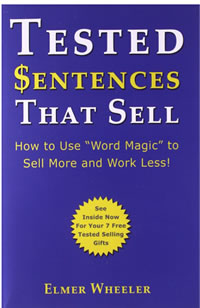
In his book Tested Sentences That Sell, Wheeler laid out his five “Wheelerpoints:”
- Wheelerpoint #1. “Don’t sell the steak – sell the sizzle.” It’s one of the first things a new copywriter learns. Sell benefits and deeper benefits. Your prospect could care less about the product.
- Wheelerpoint #2. “Don’t write – telegraph!” Back in Wheeler’s day, telegraphs were a popular way for people to send messages. But you were charged by the word, so, to keep the price down, you had to choose your words wisely. By saying “Don’t write – telegraph,” Wheeler meant “Make every word count.” He often said that your first 10 words are more important than the next 10,000, and you have only 10 short seconds to catch your prospect’s attention.
- Wheelerpoint #3. “Say it with flowers.” This simply means that it’s not enough to make a statement to your prospect, you have to prove it. In other words, say “I love you,” and then prove it by sending flowers. (Of course, you have to be sincere and do it convincingly.)
-
Wheelerpoint #4. “Don’t ask if – ask which.” Meaning, always give your prospect a choice between something and something … never between something and nothing. For Abraham and Straus, Wheeler worked out a way for their soda fountains to sell more eggs. Instead of asking “Would you like an egg with that?” the clerk would ask “One egg or two eggs?” while holding an egg in each hand. The result? It induced seven out of 10 customers to add at least one egg to their order.
I’d like to add my two cents to this one …
I’m continually surprised by how many waiters and waitresses don’t use this gentle sales technique. Most ask if you’ll be having wine with dinner. Few say “Will you be having white wine or red wine with dinner tonight?”
And, one more example from Wheeler for this point:
He noticed that when a customer at the soda fountain requested a cola and was asked whether they wanted “small” or “large,” most chose “small.” He wondered what would happen if the clerk, instead, just said “Large one?” When they put it to the test, they found that seven out of 10 people said “Yes.” This simple idea could have a dramatic impact on a fast food restaurant’s bottom line. If they sell 500 drinks a day and the difference between a small and a large is 50 cents, converting 70% of their drink orders to large translates into an additional $175 per day. Over a year, that’s an increase of $63,875!
- Wheelerpoint #5. “Watch your bark!” This one came out of Wheeler’s love of dogs – and how much you can tell about how a dog feels by the way they wag their tails and the sound of their barks. So by saying “Watch your bark!” Wheeler’s reminding us that it’s not just what you say, but how you say it. For copywriters, that means keeping the tone of your copy conversational and engaging.
I’ve printed out these five Wheelerpoints and taped them up next to my computer. They’re as meaningful for all of us in the “persuasion business” today as they were when Elmer came up with them 60+ years ago.
[Ed. Note: Have you come across any good books that your fellow copywriters might not know about? If so, we’d like to hear what they are and why you think they’re valuable. Send us a note.]
The AWAI Method™ for Becoming a Skilled, In-Demand Copywriter
The AWAI Method™ combines the most up-to-date strategies, insights, and teaching methods with the tried-and-true copywriting fundamentals so you can take on ANY project — not just sales letters. Learn More »

This account of the contributions of Mr. Wheeler is a testament that words of wisdom really do endure. We would all do well to follow in the footsteps of the sages, before striking out on our unique paths.
Thanks for sharing!
E I Christmas –
Just a rookie and everything is moving entirely too fast. I would ask "what have you done for me today"? No disrespect intended here. I fully grasped all implied and obvious benefits of these profound words. To answer my own question, I say this:
If skills of reading, recopying, and doing these again make me near the person Mr. Wheeler was believed to be, I will be elated and thankful.
msunderwood –
Elmer Wheeler certainly had the knack of making it hard to say 'no thanks'. I hope I can come up with some ideas as great as his.
Istvan –
I agree words of wisdom go a lot farther and absolutely needed everyday. I'm trying to be a believer in this course and in myself. Read on, right...
YorkyMom –
Excellent! Proves what I have always thought...you can get sucessful results from anything you say to someone if you know how to say (or in this case) write it!
praygirl –
John Wood did an excellent job.
Caught my interest and held it with solid quotes and a website for additional information.
Thanks
Olde Fox –
Because my background includes 30 years in sales, I've had the opportunity to use Wheeler's techniques in B2B selling--they work.
Rick Hendricks –
I'm finding things I've looked for for years. WOW this is info worth remembering and using.
Guest (Bryce Canfield) –
It feels like the easy conversation a brother or family member might use and flips you into believing they have your best interests at heart...
Pauline –
It would be great to check modern texts to avoid the phrases or out-dated attitudes reflected by Wheeler--he was a sales genius but today's world of advertising wouldn't go for his reflections on his wife who wanted a hat...modern ethics in coaching avoid the 'why' word or at least informed a person they are being 'tested'--however, even more important is to avoid looking down on someone as 'silly'. One wonders what their relationship was. Something like from an Ibsen play?
English Makes Cents –
The information is so interesting. I look forward to learning the skills of focusing on the benefits, benefits, benefits. Am I the only person with writers cramp? :-)
KathPoole –
I thought Zig Ziggler used to say all those things but I guess he got it from Wheeler. Either way, they keep passing them down from generation to generation, that tells you something, they work and transcend generations of time.
Guest (Ronald Gaiser) –
Thanks for sharing Mr. Wheeler's wonderful words of sales wisdom. I was working my way through the text before my next copywriting assignment and had to pull up my Word program to write them down!
RobynM –
Excellent points by Elmer Wheeler! I've always used one of his quotes, "It's not what you say, but how you say it". I'm going to print this out and hang it where I can read it on a daily basis. Thanks!
Will-ingToWrite –
Very correct style and right approach for good selling technique.
Now a new technique of offering freebies has also the desired effects
Turab –
Liked it very much!
Dragonfly –
This is an important teaching article. Thank you John for sharing it with us. I especially like Wheelerpoint #4: "Don't ask if - ask which." To which I would ask my prospect: "Do you want to achieve financial freedom in one year or three years?" Not: Would you like to achieve financial freedom?"
Loving this course!
Angela Coupe –
Mr. Wheeler, in my opinion, making concise copywriter guidelines. To me they are benefits, short attention getting words, supporting statements, choices over questions, and engagingly involving the prospect.
Ed Todd –
This concept is a great teaching tool, coming from a sales background and experience of not asking open ended questions lead where you want them to go. Thanks
Vincent –
I just copied and pasted Mr. Wheelers, Wheelerpoint's to print out! Thanks so much for these helpful stories and the comments are wonderful too.. Just started this venture and am very excited by what I am reading!!
Donna Ornduff –
This was worth printing and putting on my wall to remind me how a few simple words can change the dynamics of any situation!
Marie Casiglio –
Will, thank you. You & the AWAI staff are having a meaningful impact on lives, even whole families, with your work and advice. I can't wait to take the financial products copywriting course. My plan is to use it first to revamp my own annuities sales after medical issues dampened my business, but then to exit annuities sales to offer 30+ years of selling them as a way to add credence to my (soon to be) great copywriting... thanks to AWAI!
Dan Gallagher –
I want the sizzle! What a compelling image, succinctly conveyed.
Writerinfact –
John,$5000 for 9 words,wow! Way to drive a point home. I so appreciate these keys in the 5 Wheeler Points-sell benefits and greater benefits,make every word count,be sincere and convincing,give a choice of something and something not something or nothing ( I will go back and revise my sample copywriting query I just wrote to a company I desire to write for, hah, timing is everything!!),and keep voice and tone conversational. Thank you for sharing this treasure of information.
Guest (Rita Jeane Smith) –
Thank you, John, for passing along Mr. Wheeler's gems! I especially like the "Watch your bark!" I'll soon be writing copy to market my husband's technical education book we're selling to students and educators, and I know I'll have to keep stressing that point to my sweetie. Engineers are often long on the technical explanations and short on conversational! Conversational and engaging, conversational and engaging...
If I get some resistance, I'll have hime read this article, and maybe Elmer's book!
Andrea Arthur Owan –
Wow! This was absolutely refreshing with lots of encouragement. I've got to have that book! I too love Wheeler Point #4 - "Don't ask if, . . . ask which!" That makes so much sense to me! I tell myself, I will become a copywriter, no matter what!
Bob L –
I will take the steak with the sizzle!
Kathy Bjorn –
These articles and comments are great. Shows the power of words and the impact simple words and phrases have on all of us.
Teresa Lund –
Powerful information to live by! Wheeler was a genius in my book.
PNB –
The action words or words that appeal to the senses seem to resonate with folks needs and desires the impact is timeless.
Teresa Lund –
Love these tips! I wrote them in my appointment book so that I will always have them with me. Priceless information!
Guest (Colleen) –
I am amazed how Elmer's 5 testing sentences come up in everyday life. For example, it's not necessarily what we say but how we say it. It can make all the difference between constructive and destructive conversation / marketing. I see now why, on tv commercials, many times I don't even know what they are trying to sell. Now I know they are selling benefits with just a mention of the product, or not. Thanks John for this great offering. I will be posting this up for constant referrence. Cynde
Cynde Jackson –
Wheelerpoints really caught my mind and woke it up.
Bret –
Excellent Advice! I may like to get the book "Tested Sentences That Sell"!
Wanda F Sewell –
I like the proving point. When sellers can't prove anything to buyers, sales aren't made. PROVE baby PROVE
Guru Lwanga –
I love reading about the marketing geniuses of old. These techniques have worked since folks were sexting each other via telegram!
They still work today because people are the same as they've always been.
The good news: people won't ever change!
Brandon Radaker –
Great one!
Mang Lyanzaw –
Great Nuggets from Mr Wheeler.
Jay Williams –